

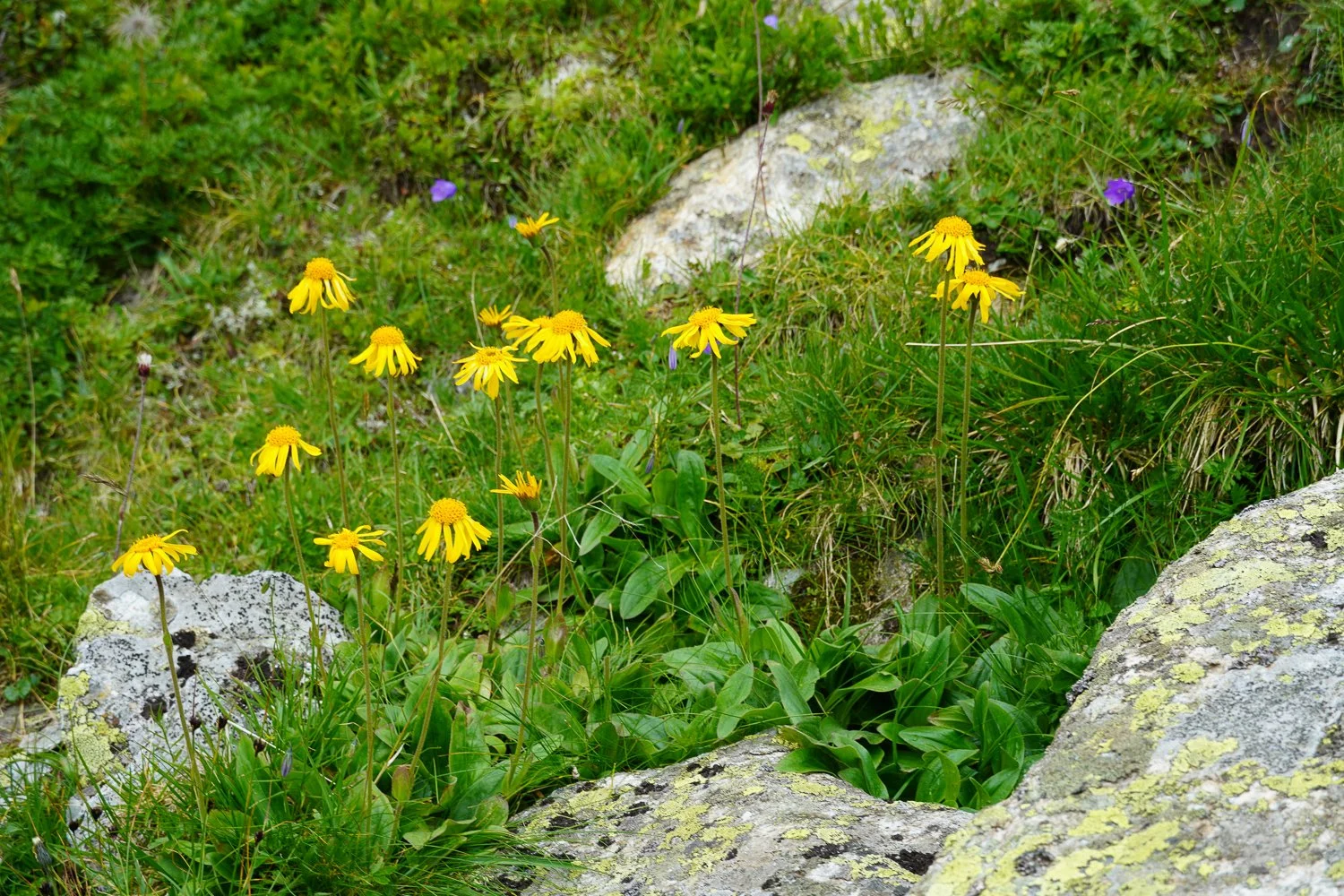
Arnica montana, Hohe Tauern National Park, Carinthia, Austria. Photo by Naturpuur, 12 August 2020. Licensed under CC BY 4.0, via Wikimedia Commons.
There are some plants whose reputation seems to travel ahead of them.
Arnica is one of those plants.
For centuries, its bright golden flowers have been gathered and prepared for the everyday injuries of human life — the bruises, sprains, aching muscles and knocks that come with work, travel, play and simply moving through the world.
Long before the mechanisms of inflammation were mapped in laboratories, Arnica had already earned a place in European herbal medicine.
And perhaps that is part of what makes medicinal plants so fascinating: sometimes modern research does not begin the story. It arrives hundreds of years into it.
A flower of the mountains
Arnica montana L. belongs to the Asteraceae family — the same broad botanical family as daisies, chamomile and calendula.
It is a perennial mountain plant native to Europe, growing through montane and alpine regions in nutrient-poor, acidic soils. Its natural range stretches through parts of northern and central Europe and south towards Portugal, where it is found in mountain pastures, heaths and open grassland.
The plant itself is relatively modest, generally reaching somewhere between 15 and 60 centimetres in height. A rosette of leaves sits close to the ground, while upright stems carry its unmistakable golden-yellow flower heads.
Those flowers are the part most closely associated with modern herbal medicine.
Although the leaves, roots and aerial parts have all been used historically, today it is predominantly the flower head — known pharmaceutically as Arnicae flos — that is used in herbal preparations.
The European Pharmacopoeia specifically recognises the flowers of Arnica montana, distinguishing them from the numerous other species within the Arnica genus.
Over the centuries, Arnica montana has also gathered a number of common names, including leopard’s bane, mountain arnica, mountain tobacco, mountain snuff and wolf’s bane.
The last of these can be a little confusing, because “wolf’s bane” is also used for Aconitum, an entirely different and highly poisonous plant. In herbal medicine, botanical names matter for exactly this reason.
Arnica in Australia
Although Arnica’s story is deeply European, Arnica montana is not native to Australia.
In its natural habitat it grows in cold, mountainous areas and alpine meadows, including regions at elevations of up to around 3000 metres.
Growing it in Australia therefore means trying to recreate at least some of the conditions it naturally prefers.
It is best suited to cold and temperate climates, with cool growing conditions and well-draining soil. Australian growers may find it challenging in warmer areas because the plant is adapted to European mountain environments.
Australian seed suppliers recommend cool germination temperatures and note that established plants tolerate quite cold conditions, reinforcing just how strongly Arnica montana belongs to its mountain habitat.
That makes the golden flowers all the more interesting: this is a plant shaped by altitude, cold and poor soils, yet one that has become familiar far beyond the landscapes where it originally grew.
A medicine with centuries behind it
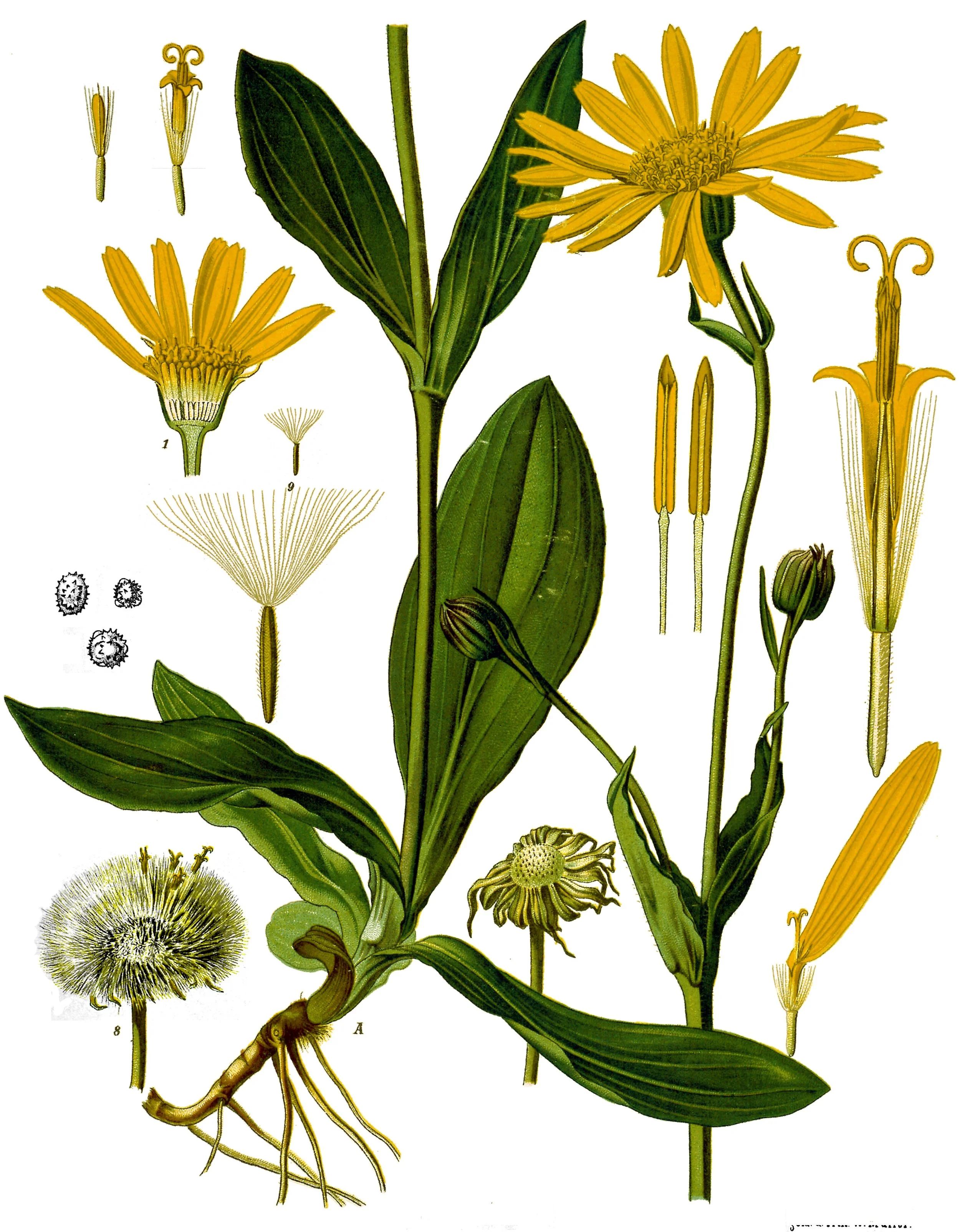
Arnica montana, Franz Eugen Köhler, Köhler’s Medizinal-Pflanzen, 1897. Public domain, via Wikimedia Commons.
Arnica’s medicinal history reaches deep into European herbal tradition.
Historical records place its use from the Middle Ages onwards, and references to Arnica appear throughout old European herbal texts. By the 18th and early 19th centuries, it had become an increasingly important medicinal plant.
Herbalist and Benedictine abbess Hildegard of Bingen, who lived from 1098 to 1179, is among the historical figures associated with Arnica in the herbal literature.
By later centuries its reputation had expanded considerably.
Historically, Arnica was used for bruises, sprains, swellings, wounds and muscular complaints, while older texts also describe preparations for fevers, sore throats and a variety of internal conditions.
Even Johann Wolfgang von Goethe (1749–1832) is reported in the herbal literature to have taken Arnica tea for angina.
That is an interesting piece of herbal history — but not a recommendation worth resurrecting.
Our understanding of safety has changed substantially since Goethe’s time.
Internal herbal use of Arnica was gradually abandoned during the 20th century because of its toxicity when ingested. Modern herbal practice therefore uses Arnica externally, rather than internally.
The evolution is a good reminder that traditional medicine is not static. Herbal traditions have always changed as observation, experience and scientific knowledge have grown.
Traditional Arnica
Within Western herbal medicine, Arnica montana has become particularly associated with injury and inflammation.
Traditionally, external preparations have been used for:
bruising
sprains and strains
muscular soreness and aching
painful swellings
localised joint and muscle inflammation
haematomas
insect bites
swelling associated with minor injuries
European herbal authorities have continued to recognise many of these traditional uses.
The European Medicines Agency’s Committee on Herbal Medicinal Products recognises Arnica flower preparations as traditional herbal medicines for the relief of bruises, sprains and localised muscular pain.
Importantly, the language here is deliberate.
A traditional herbal indication reflects a long history of medicinal use rather than suggesting that centuries-old practice and modern pharmaceutical-style clinical evidence are the same thing.
They are different forms of knowledge.
But that long history matters.
For a medicinal plant to continue appearing in European herbal practice across generations, pharmacopoeias and medicinal traditions is part of Arnica’s story — and one of the reasons researchers continue to investigate it today.
What is inside Arnica?
The golden flowers of Arnica montana contain a complex collection of naturally occurring plant compounds.
Among the most important are a group known as sesquiterpene lactones, particularly helenalin and related dihydrohelenalin compounds.
These constituents are considered central to many of Arnica’s biological effects.
The flowers also contain flavonoids, volatile oils, phenolic compounds, polysaccharides, carotenoids, tannins and other plant constituents.
This is one of the great differences between whole-plant herbal medicine and a medicine based around a single isolated molecule.
A herb is not one substance.
It is a collection of compounds existing together within the plant.
Researchers investigating Arnica montana have found that its sesquiterpene lactones can influence several inflammatory pathways.
One particularly interesting area involves NF-kappa B, or NF-κB — a signalling pathway involved in regulating the expression of numerous inflammatory mediators.
Helenalin and related Arnica compounds have demonstrated the ability to inhibit activation of this pathway in experimental research.
Other laboratory research has identified antioxidant, antimicrobial and immune-related activity among Arnica constituents.
These findings help provide possible biological explanations for some of the uses herbalists have associated with Arnica for generations.
Tradition meets modern research
Modern investigations into topical Arnica montana have produced encouraging findings.
Clinical research discussed by Kerry Bone (2003) has reported benefits from topical Arnica preparations for muscular discomfort and joint pain.
In research cited by Bone, topical Arnica gel was associated with improvements in pain and stiffness in people with mild to moderate osteoarthritis of the knee.
Other clinical research has found topical Arnica preparations beneficial for muscle ache.
Arnica gel has also been investigated in people with chronic venous insufficiency, where it was associated with improvements in feelings of heaviness in the legs, venous tone and oedema.
Perhaps most interestingly, these modern investigations are exploring complaints that look remarkably familiar when placed beside Arnica’s traditional herbal uses: bruising, muscular discomfort, inflammation, swelling and injury.
The language may have changed.
The questions have become more scientific.
But the plant being investigated is the same golden flower herbalists have been reaching for across centuries.
Why the flower?
Today, the flowers of Arnica montana are the primary medicinal part used in phytotherapy.
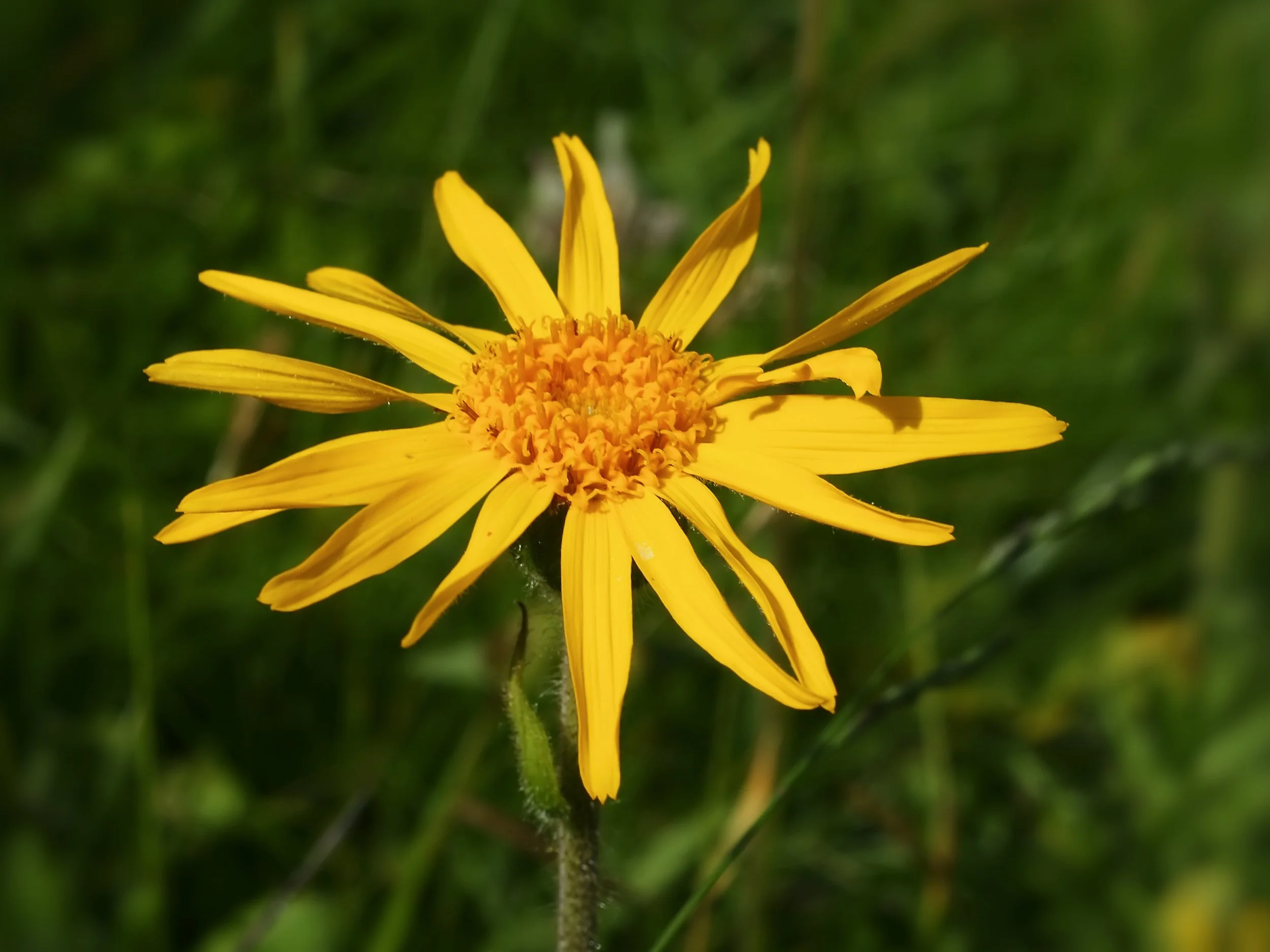
Arnica montana (Wolf’s bane), Hans Hillewaert, 20 July 2008. CC BY-SA 3.0, via Wikimedia Commons.
Traditionally they may be harvested while in full bloom and used fresh or dried.
The concentration of Arnica’s active constituents is not necessarily identical throughout every part of the plant, or even throughout every stage of flowering.
Research has found that sesquiterpene lactone concentrations vary according to the part of the flower and its stage of maturity.
Helenalin, for example, occurs at particularly high concentrations within the disc florets at the centre of the flower head.
This is one of the quiet complexities of herbal medicine.
A medicinal plant is influenced by its species, growing environment, harvesting time, plant part and preparation method.
Two things labelled simply “Arnica” are not automatically identical.
A herb to respect
Arnica’s long history does not make it a herb to use carelessly.
Quite the opposite.
Traditional herbal medicine has always included an understanding that plants can be powerful as well as useful.
Modern herbal Arnica preparations are intended for external use only.
Arnica montana should not be taken internally, and topical preparations should generally be applied only to intact, unbroken skin.
Arnica can also cause irritation or allergic contact dermatitis in some people. Particular caution is appropriate for anyone with a known sensitivity to Arnica or other plants within the Asteraceae family.
Prolonged application is not recommended.
The way Arnica is used today therefore looks rather different from some of the remedies described hundreds of years ago.
And that is not a rejection of tradition.
It is tradition continuing to evolve.
The plant behind the yellow flowers
It is easy to look at a jar, cream or bottle containing a herbal extract and forget that the story began somewhere else entirely.
In Arnica’s case, it begins high in the European landscape with a small perennial bearing golden flowers.
Those flowers became part of European folk medicine.
They appeared in medieval herbal traditions.
Their use continued through the 18th and 19th centuries.
Eventually their chemistry entered laboratories, where researchers began asking why this old mountain remedy had acquired such an enduring reputation.
Today, Arnica montana remains closely associated with bruises, sprains and sore muscles — the same kinds of complaints for which generations before us knew the plant.
Perhaps that continuity is one of the most beautiful things about herbal medicine.
Not that every old belief must automatically be accepted as fact, but that knowledge can travel through centuries — observed, questioned, refined and investigated — while the plant at the centre of the story remains recognisably the same.
A little golden flower from the mountains.
And a medicinal history stretching back hundreds of years.
A note on safe use
This article explores the history and traditional use of Arnica montana and is intended for educational purposes only. Herbal Arnica preparations are for external use and should not be taken internally. Avoid application to broken skin and discontinue use if irritation occurs. Individual products may have different directions and precautions; always follow the label and seek professional healthcare advice when appropriate.
References
Bone, K. (2003). A clinical guide to blending liquid herbs: Herbal formulations for the individual patient. Churchill Livingstone.
Fisher, C. (2018). Materia medica of Western herbs. Aeon Books.
Schmidt, T. J. (2023). Arnica montana L.: Doesn’t origin matter? Plants, 12(20), 3532. https://doi.org/10.3390/plants12203532
The Seed Vine. (n.d.). Arnica montana – Wolf’s Bane.
van Wyk, B.-E., & Wink, M. (2017). Medicinal plants of the world. CAB International.
